If you have a three-year-old, you have probably found yourself wondering, “What should my 3-year-old know by now?” Maybe you’ve watched another child count higher, recognize more letters, speak more clearly, or write their name and wondered whether your child is where they should be.
Hi, I’m Velvet Mumma
Mom. Early Childhood Specialist. Blogger.
I’ve spent years studying early childhood development and working with young children, and one thing I want every parent to remember is this: three-year-olds are still very little.
Age three is an exciting period of tremendous growth. Your child is learning to communicate, become more independent, understand emotions, solve problems, move their body in new ways, and make sense of the world around them.
But development isn’t a race, and this isn’t a checklist your child has to complete before their fourth birthday.
Instead, think of this guide as a look at the skills you can notice, encourage, introduce, and practice with your three-year-old.
Let’s look at what your little learner may be working on.
What Development Looks Like at Age Three
One of the most important things to understand about child development is that it doesn’t happen evenly.
Your child might be an incredible talker but still struggle with scissors. Another three-year-old may recognize many letters but need help communicating when they’re upset. One child may climb everything in sight while another would rather sit quietly completing puzzles.
All of those children are learning.
When we look at a three-year-old’s development, we’re looking at the whole child, including:
- Language and communication
- Early literacy
- Early math
- Cognitive development
- Fine motor development
- Gross motor development
- Social development
- Emotional development
- Self-help skills
- Independence
Academics are only one small part of school readiness.
Knowing how to ask for help, follow a simple routine, communicate a need, put away toys, listen to a story, and play around other children can be just as valuable at this age as knowing letters and numbers.
Language and Communication Skills for 3-Year-Olds
Three-year-olds often have a lot to say!
You may notice your child talking more throughout the day, asking question after question, and wanting to tell you about everything they see.
Many children around this age are developing skills such as:
- Speaking in short sentences
- Asking questions
- Naming familiar people and objects
- Communicating wants and needs
- Following simple two-step directions
- Participating in short conversations
- Using words such as I, me, you, and we
- Using descriptive words
- Talking about something that happened earlier
- Retelling simple experiences
- Becoming easier for familiar adults to understand
And yes—the endless “Why?” questions are learning too!
When your child asks questions, they are gathering information and trying to understand how their world works.
How to Build Your 3-Year-Old’s Language at Home
You don’t need special lessons to encourage language development.
Talk to your child. A lot.
If you’re making breakfast, talk about what you’re doing.
“We need two eggs. Let’s crack the first egg. Now we need one more.”
If you’re getting dressed, talk about clothing.
“Your shirt is blue today. Can you find your white socks?”
Read books, sing songs, tell stories, ask questions, and give your child opportunities to talk.
Instead of always asking questions with one-word answers, try questions such as:
“What do you think will happen next?”
“What was your favorite part?”
“How do you think she feels?”
Those little conversations add up to an incredible amount of learning.
Early Literacy and Pre-Reading Skills
Parents sometimes hear “preschool readiness” and immediately think their child needs to be reading.
They don’t.
At three, we’re building the foundation for reading.
Your child may begin to:
- Enjoy listening to books
- Choose favorite stories
- Hold a book and turn the pages
- Understand the front and back of a book
- Recognize their own name
- Notice letters around them
- Recognize some familiar letters
- Listen for rhyming words
- Join in while you read familiar stories
- Pretend to read
- Understand that words on a page have meaning
- Begin connecting some letters with their sounds
If your child recognizes the giant golden arches and announces that you’ve passed McDonald’s, that’s an early form of reading called environmental print awareness.
Children begin learning that symbols, letters, pictures, and words carry meaning long before they can independently read a book.
Read Every Day
One of the simplest things you can do for early literacy is also one of the most powerful:
Read together every day.
You don’t have to turn every book into a lesson.
Snuggle up. Look at the pictures. Make silly voices. Ask questions. Let your child interrupt. Let them turn the pages. Read their favorite book for the hundredth time.
Those experiences help build vocabulary, comprehension, attention, print awareness, and—most importantly—a positive relationship with books.
Early Writing and Pre-Writing Skills
Before children can write letters neatly, their hands need to become strong enough to control a pencil.
That’s why scribbling matters.
Your three-year-old may be learning to:
- Scribble intentionally
- Draw lines
- Make circular shapes
- Attempt simple drawings
- Copy basic lines and shapes
- Hold and manipulate crayons and markers
- Make letter-like marks
- Recognize their written name
- Attempt some letters
Don’t worry if your child’s “writing” doesn’t look much like writing yet.
When your child hands you a page covered in scribbles and proudly says, “This says I love Mommy,” that is meaningful early writing.
They understand that marks can communicate a message.
Build the Hands Before Pushing Handwriting
Before spending lots of time tracing letters, give your child opportunities to strengthen their hands.
Try:
- Play dough
- Blocks
- Large beads
- Stickers
- Finger painting
- Chalk
- Puzzles
- Tongs
- Clothespins
- Tearing paper
- Child-safe scissors
Strong little hands eventually make writing easier.
Early Math Skills for 3-Year-Olds
Math at three should be hands-on.
Your child may be beginning to:
- Say some numbers in order
- Count small groups of objects
- Touch objects while counting them
- Recognize some written numbers
- Understand more and less
- Sort objects
- Match objects
- Recognize simple patterns
- Compare sizes
- Understand basic position words
Instead of asking your child to complete pages of math problems, bring math into everyday life.
Count blueberries.
Sort toy cars by color.
Build towers and decide which is taller.
Find three red blocks.
Put the teddy bear under the chair.
Give everyone one napkin at dinner.
That’s preschool math.
Colors and Shapes
Many three-year-olds are learning the names of common colors.
You can introduce:
Red, orange, yellow, green, blue, purple, pink, brown, black, and white.
Your child can also begin recognizing common shapes such as:
Circle, square, triangle, rectangle, oval, heart, and star.
But don’t feel like you need to drill your child with flashcards.
Look for shapes in real life.
The plate is a circle.
The window looks like a rectangle.
The cracker is a square.
The yield sign is a triangle.
When children connect concepts to their actual environment, those concepts become meaningful.
Cognitive and Thinking Skills
Your three-year-old’s brain is busy trying to figure out how everything works.
You may see your child:
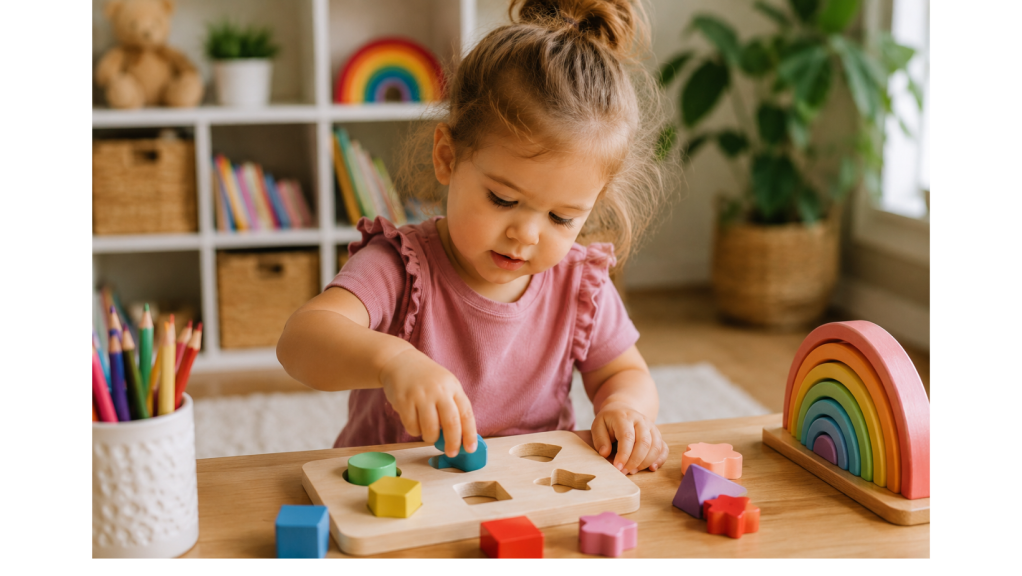
- Complete simple puzzles
- Match pictures and objects
- Sort objects by color, shape, or size
- Remember familiar routines
- Understand simple cause and effect
- Solve simple problems
- Remember parts of familiar stories
- Make choices
- Use imagination
- Engage in pretend play
Pretend play is especially important.
When your child turns a cardboard box into a spaceship or pretends a block is a telephone, they are using symbolic thinking.
They’re learning that one thing can represent another—a skill that eventually supports reading, writing, mathematics, and abstract thinking.
So don’t underestimate pretend play.
It is serious learning disguised as fun.
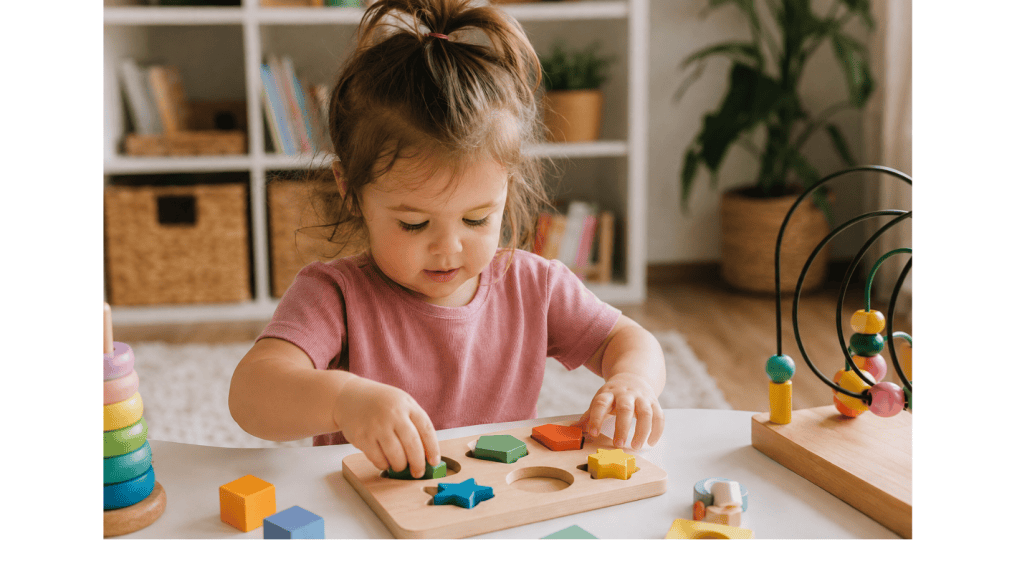
Fine Motor Skills for 3-Year-Olds
Fine motor skills involve the small muscles of the hands and fingers.
Your three-year-old can practice these skills by:
- Building with blocks
- Completing puzzles
- Stringing large beads
- Rolling play dough
- Pinching and squeezing play dough
- Using child-safe tongs
- Peeling stickers
- Painting
- Drawing
- Turning book pages
- Picking up small objects safely
- Beginning to use child-safe scissors
These activities aren’t just keeping your child busy.
They’re preparing your child’s hands for dressing, eating, cutting, drawing, and eventually writing.
Gross Motor Skills for 3-Year-Olds
Those little bodies need to move!
Gross motor development involves the large muscles of the body.
Your three-year-old may be practicing:
- Running
- Jumping
- Climbing
- Kicking a ball
- Throwing a ball
- Attempting to catch a large ball
- Walking up and down stairs
- Pedaling or learning to pedal
- Balancing briefly
- Dancing
- Participating in movement games
Give your child plenty of opportunities to move every day.
Go outside. Run. Dance in the living room. Play follow-the-leader. Kick a ball. Make an obstacle course.
Movement is part of learning too.
Social Skills at Age Three
Three is an interesting age socially.
Your child is beginning to notice other children more and may move from simply playing beside them toward actually interacting with them.
They may begin:
- Playing with other children
- Developing friendships
- Practicing sharing
- Taking turns with help
- Joining simple group activities
- Imitating other children
- Following simple rules
- Asking adults for help
- Learning to solve small conflicts
Notice that I said practicing sharing and taking turns.
A three-year-old isn’t necessarily going to cheerfully hand over their favorite toy because another child wants it.
Social skills are learned through repeated experiences.
They need practice, modeling, reminders, and adult support.
Emotional Development at Age Three
Three-year-olds can have very big emotions in very little bodies.
Your child may begin identifying basic feelings such as:
- Happy
- Sad
- Mad
- Scared
- Excited
They may also begin recognizing emotions in other people.
“You’re sad, Mommy.”
“The baby is crying.”
“He’s mad.”
These are important early emotional-development skills.
Three-Year-Olds Still Have Tantrums
Knowing the word angry doesn’t mean a three-year-old suddenly knows what to do with anger.
Emotional regulation develops gradually.
Your child still needs you to help them calm down, identify what they’re feeling, and learn appropriate ways to express those feelings.
You might say:
“You’re angry because you wanted another cookie. It’s okay to be angry. I won’t let you hit.”
You’re acknowledging the emotion while maintaining the boundary.
Over time, these experiences help children develop their own emotional-regulation skills.
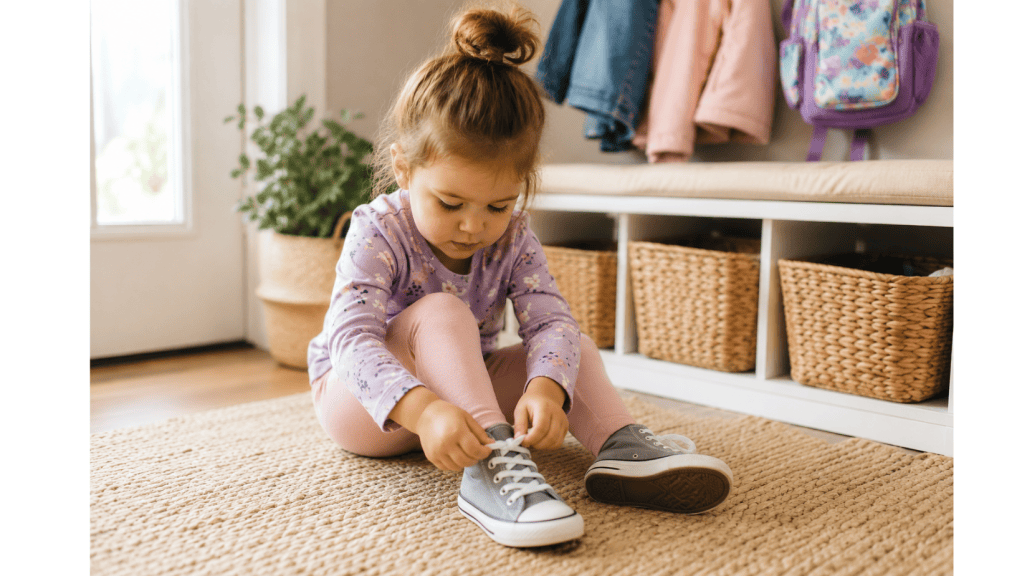
Independence and Self-Help Skills
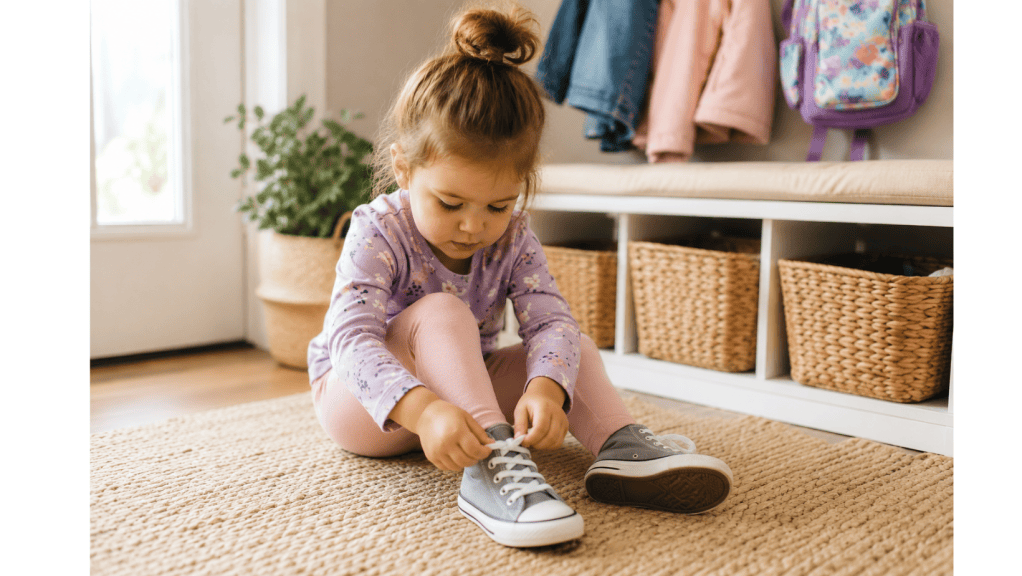
This is one area I would encourage parents to focus on just as much as academics.
Three-year-olds can begin doing a surprising number of things for themselves.
Depending on the child, they may practice:
- Washing and drying their hands
- Feeding themselves
- Drinking from an open cup
- Putting toys away
- Taking off simple clothing
- Helping dress themselves
- Putting shoes where they belong
- Carrying their belongings
- Making simple choices
- Helping with household tasks
- Practicing toileting independence when developmentally ready
It may take longer when they do it themselves.
That’s okay.
If we always do everything for children because it’s faster, we accidentally remove opportunities for them to practice independence.
Practical Life Skills Your 3-Year-Old Can Practice
Some of the best preschool activities aren’t activities we traditionally think of as “educational.”
Let your three-year-old help with real life.
They can:
- Put dirty clothes in the hamper
- Carry their plate to the table
- Put books on a shelf
- Wipe up small spills
- Help prepare simple snacks
- Water plants
- Match socks
- Sort laundry
- Put toys away
- Help set the table
A child matching socks is practicing visual discrimination and matching.
A child helping prepare lunch is learning vocabulary, sequencing, math, fine motor skills, and independence.
Learning is everywhere once you start looking for it.
Play Skills at Age Three
If there is one thing I want parents to take from this guide, it is this:
Let your three-year-old play.
Play is not what children do when they’re finished learning.
Play is how young children learn.
Provide opportunities for:
- Pretend play
- Blocks
- Sensory play
- Art
- Music
- Dancing
- Outdoor play
- Puzzles
- Dramatic play
- Simple games
- Books
- Playing with other children
A pretend grocery store can involve counting, sorting, vocabulary, social skills, writing, environmental print, problem-solving, and imagination—all without a worksheet.
What Does a 3-Year-Old NOT Need to Know?
This section may be the one some parents need most.
Your three-year-old does not need to:
- Read independently
- Write complete sentences
- Complete piles of worksheets
- Sit through long academic lessons
- Know every letter and sound
- Count to 100
- Complete kindergarten-level math
- Color perfectly inside the lines
- Write their full name perfectly
- Know everything another three-year-old knows
There is nothing wrong with a three-year-old learning advanced skills when they’re interested and ready.
The problem comes when we begin treating those skills as requirements for every child.
Challenge your child without rushing their childhood.
So, What Should I Actually Teach My 3-Year-Old?
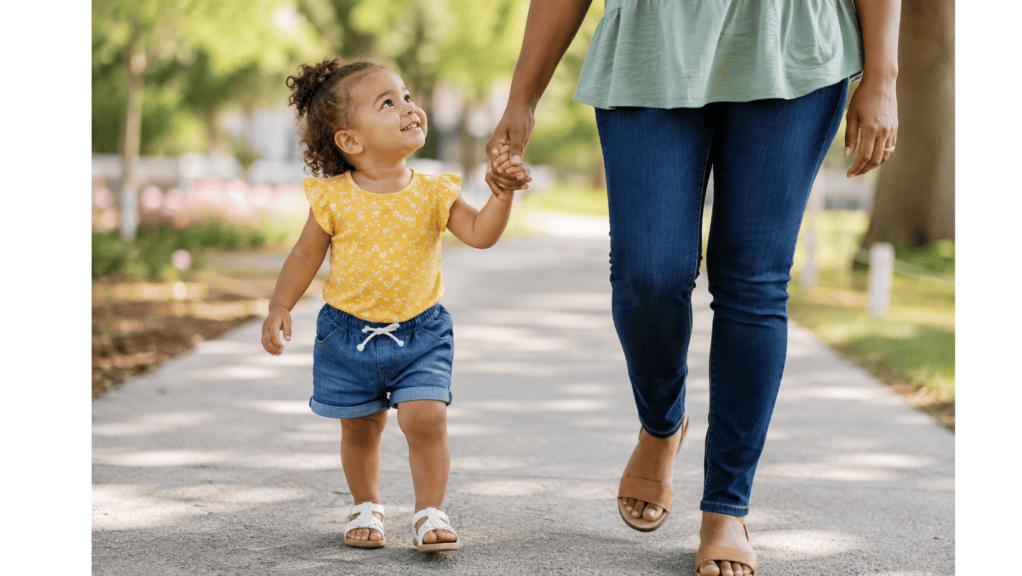
If you’re wondering where to focus, I’d prioritize these areas:
- Communication
- Independence
- Play
- Social skills
- Emotional vocabulary
- Books and early literacy
- Counting and early number concepts
- Fine and gross motor skills
- Curiosity and problem-solving
- A love of learning
If your child enters preschool curious, comfortable asking questions, interested in books, willing to explore, increasingly independent, and able to communicate their needs, you’ve already helped build a wonderful foundation.
A Simple Daily Learning Routine for a 3-Year-Old
You don’t need to recreate an elementary school day at home.
A simple routine might look something like this:
Morning
Eat breakfast and talk together.
Read a book.
Spend a few minutes on a simple learning activity—perhaps letters, counting, colors, shapes, or a puzzle.
Mid-Morning
Let your child choose from activities such as:
- Blocks
- Dramatic play
- Art
- Sensory play
- Puzzles
- Books
Then get outside and move.
Afternoon
After lunch and quiet time, try something simple such as:
- Cooking together
- Painting
- Reading
- A science activity
- Play dough
- Music
- A counting game
- Outdoor exploration
And remember that learning continues throughout the day.
20 Simple Things to Practice With Your 3-Year-Old
Here are twenty skills you can naturally work into your child’s day:
- Say their first name.
- Recognize their name in print.
- Count small groups of objects.
- Identify common colors.
- Identify basic shapes.
- Listen to a short story.
- Turn book pages.
- Sing nursery rhymes.
- Follow simple two-step directions.
- Ask for help.
- Clean up toys.
- Wash their hands.
- Feed themselves.
- Draw and scribble.
- Play with play dough.
- Complete simple puzzles.
- Run, jump, and climb.
- Practice taking turns.
- Name basic emotions.
- Participate in pretend play.
You don’t have to sit down and “teach” all twenty.
Most of these can happen naturally through everyday life.
When Your Child Doesn’t Follow the Checklist
Developmental lists can be helpful, but they can also make parents anxious.
Remember that developmental milestones aren’t a competition between children.
Look at your whole child.
One child may talk early. Another may develop physical skills quickly. Another may be extremely social. Another may quietly observe before joining an activity.
There is room for individual development.
At the same time, parents know their children well. If you’re concerned about your child’s communication, movement, hearing, behavior, social interaction, development, or loss of a skill they previously had, talk with your child’s pediatrician or another qualified developmental professional.
You don’t have to wait until preschool or kindergarten to ask questions about development.
Turn Everyday Life Into Preschool
One of my favorite things about early childhood education is that you don’t need an expensive curriculum to create meaningful learning experiences.
Your home is already filled with opportunities.
At breakfast: Count strawberries.
While getting dressed: Name colors.
During laundry: Match socks.
At the grocery store: Find letters and numbers.
While cooking: Count, pour, stir, measure, and describe.
Outside: Collect leaves, compare sizes, and look for insects.
During cleanup: Sort toys.
At bedtime: Read stories and talk about the day.
Those ordinary moments are packed with language, math, science, literacy, and life skills.
Preparing Your 3-Year-Old for Preschool
If preschool is coming soon, you don’t need to spend the summer drilling flashcards.
Instead, help your child become comfortable with the routines they’ll encounter.
Practice:
- Following simple directions
- Cleaning up after activities
- Washing hands
- Opening lunch containers when possible
- Carrying their belongings
- Communicating bathroom needs
- Asking an adult for help
- Sitting and listening to a short story
- Playing around other children
- Taking turns
- Separating from caregivers for short periods
- Following a predictable routine
And talk positively about school.
Preschool should feel like an exciting new adventure—not an academic test your child has to pass.
Remember: You’re Building a Foundation
At three years old, we’re not trying to produce tiny kindergarteners.
We’re building the skills that eventually make kindergarten learning possible.
Before beautiful handwriting comes hand strength.
Before reading comes language, listening, vocabulary, print awareness, and phonological awareness.
Before addition comes counting, matching, sorting, comparing, and understanding quantities.
Before independent emotional regulation comes years of adults helping children regulate their emotions.
Before independence comes hundreds of opportunities to try.
Build the foundation first.
The academics will have somewhere strong to grow.
Final Thoughts
So, what should a three-year-old know?
They should be learning about themselves, other people, and the incredible world around them.
They should be talking, listening, moving, experimenting, pretending, building, creating, asking questions, making mistakes, trying again, and becoming a little more independent.
Some days they may surprise you with what they know.
Other days they may cry because you gave them the blue cup instead of the green one.
Both can be perfectly representative of life with a three-year-old.
Don’t turn these precious years into a race.
Read together. Talk together. Cook together. Count together. Sing together. Explore outside. Build towers. Make messes. Clean them up together. Give your child opportunities to help, try, fail, and try again.
And most importantly, play.
Parents are a child’s first teachers, but that doesn’t mean your home has to become a formal classroom. Some of the most important teaching you’ll ever do happens in the ordinary moments when it doesn’t look like teaching at all.
Those little moments matter.
Until next time, Mumma. Keep helping those little wings grow.


Leave a Reply