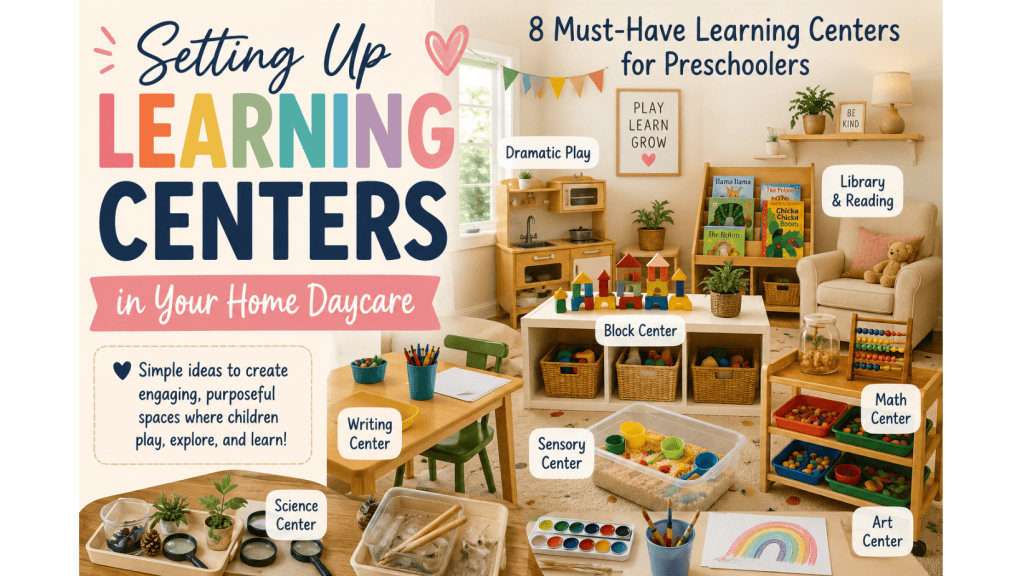
Welcome! Whether you’re a home daycare provider, a homeschooling parent teaching your little ones at home, a preschool teacher, or simply a parent who wants to create meaningful learning centers for your child, you’re in the right place. You don’t need a traditional classroom—or a huge budget—to create spaces that encourage children to learn, explore, and play. Learning centers can be created almost anywhere, from a dedicated homeschool room to a corner of your living room, playroom, or home daycare. In this article, I’ll show you how to create simple, purposeful learning centers that work for real homes and help young children develop important skills while doing what comes naturally to them: playing.
Introduction: Turning Your Home Into a Place for Learning
Hi! Im Velvet Mumma.
Mom. Early Childhood Specialist. Blogger.
Im a mom, early childhood specialist, and someone who truly believes that some of the most meaningful learning happens through play. After years of studying early childhood development and working with young children, I’ve learned that children don’t need a picture-perfect classroom filled with expensive materials to learn. They need a safe, inviting environment that gives them opportunities to explore, create, pretend, build, ask questions, and discover.
Right now, I’m putting that belief into practice as I design and set up my own home daycare. One of my biggest goals is to create a space that still has the warmth and comfort of home, while offering children many of the same intentional learning opportunities they would find in a high-quality preschool classroom.
That’s where learning centers come in.
Instead of simply filling the room with toys, I’m creating purposeful areas where children can choose activities and learn through hands-on play. My home daycare will include a dramatic play center, art center, writing center, math center, science and discovery center, block center, library, and sensory center. Each area has a purpose, but that doesn’t mean it has to be large, elaborate, or expensive.
And if you’re working with a small space, don’t worry. You don’t need eight separate rooms—or even eight large corners—to make learning centers work in a home daycare. Some centers can share tables, materials can be rotated, and even a small shelf or basket can become an intentional learning space.
In this article, I’ll walk you through the learning centers I’m including in my home daycare, what I’m putting in each one, and the developmental skills children can build while they play. Whether you’re opening a new home daycare, redesigning your current space, or simply looking for ways to make your playroom more educational, I hope these ideas help you create a space where little ones can feel at home while doing what they do best—learning through play.
Why Learning Centers Matter in a Home Daycare
Young children learn best when they are actively involved in what they are doing. They want to touch, build, pretend, pour, sort, draw, investigate, and ask a million questions along the way. Learning centers give children the freedom to do exactly that. Instead of spending most of the day sitting at a table completing worksheets or being directed by an adult, children have opportunities to move throughout their environment, make choices, and learn through meaningful play.
One of the things I love most about learning centers is that children often don’t even realize how much they are learning. A child building a tall tower in the block center is experimenting with balance, shapes, spatial relationships, and problem-solving. Two children pretending to run a restaurant in dramatic play are practicing language, social skills, cooperation, and even early math. A preschooler drawing a picture and “writing” a grocery list is strengthening the fine motor and early literacy skills that will eventually help with handwriting and reading.
Well-planned learning centers can support almost every area of early childhood development, including language, literacy, math, science, creativity, fine motor skills, problem-solving, independence, social-emotional development, and executive functioning. They also allow children to learn at their own developmental level. A two-year-old and a four-year-old may use the same center very differently—and that’s exactly what we want.
Learning centers are especially valuable in a home daycare because we often care for children of different ages, abilities, and interests in the same space. Centers make it easier to provide a variety of experiences without expecting every child to do the same activity at the same time. Children can gravitate toward activities that interest them while we observe, interact, ask questions, introduce new vocabulary, and gently extend their learning.
And remember, a learning center does not have to be big or expensive to be effective. You don’t need an enormous classroom filled with brand-new furniture and shelves of educational toys. A cozy corner with books can become your library. A small table with paper, crayons, and pencils can become your writing center. A basket of blocks on a rug can become an incredible space for engineering and imaginative play.
The goal isn’t to recreate a traditional school classroom inside your home. The goal is to thoughtfully arrange your environment so that children are invited to play with purpose, explore independently, and learn naturally throughout their day. When we create spaces that encourage curiosity, we’re giving children something far more valuable than a room full of toys—we’re giving them opportunities to become confident, capable little learners.
Before You Start: Think About Your Space
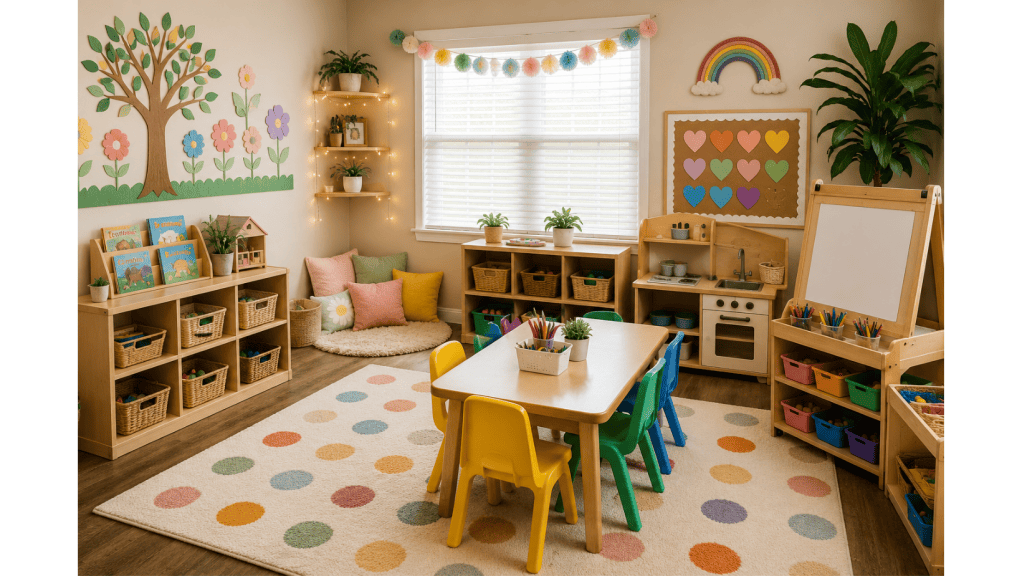
Before you start buying shelves, tables, bins, and cute classroom decorations, take a good look at the space you already have. One of the biggest advantages of creating learning centers at home is that you can design them around your space, your children, and your needs. Your setup does not have to look like the beautiful preschool classrooms you see online to be effective.
Start by thinking about the ages of the children who will use the space. A learning environment designed for two-year-olds will look very different from one designed for four- and five-year-olds. If you’re operating a home daycare with mixed ages, you’ll need to think carefully about which materials can safely remain accessible and which ones should only come out with supervision. Small manipulatives, art supplies, and certain sensory materials may be wonderful for preschoolers but unsafe for babies and young toddlers.
Think About How Children Will Move Through the Room
Traffic flow is something that’s easy to overlook when you’re excited about setting up your centers. Try to imagine several little bodies moving through the room at the same time. Can children get from one center to another without walking through someone’s block creation? Can you easily reach every child? Is there enough room for children to sit and play comfortably?
Whenever possible, use low shelves, rugs, furniture, and storage units to create natural boundaries between centers. This helps children understand where one area ends and another begins without making the room feel closed off.
Keep Quiet and Active Centers in Mind
Not every learning center works well beside another one. Your block and dramatic play centers are naturally going to be louder and more active. Your library and writing areas usually work better in a quieter part of the room.
If possible, group your active centers together and create a calmer area for reading, writing, puzzles, and other quiet activities. Even in a small room, a little thoughtful placement can make a big difference.
Make Sure You Can See Everyone
Supervision should always come before aesthetics. That beautiful tall bookshelf might look perfect in a certain spot, but if it prevents you from seeing a child on the other side of the room, it probably isn’t the best choice.
I prefer low furniture whenever possible because it can define the centers while still allowing me to see across the room. It also puts toys and materials at children’s level, encouraging them to make choices and become more independent.
Let Your Furniture Work Double Duty
When you’re working with a home daycare, every square foot matters. You don’t necessarily need a separate piece of furniture for every learning center.
A table can be used for writing in the morning, an art project later in the day, and lunch in the afternoon. A shelf can hold math manipulatives on one side and science materials on another. Materials that aren’t being used can be stored and rotated instead of having everything available all the time.
Multipurpose spaces are your friend.
Don’t Try to Fill Every Inch
It can be tempting to keep adding things because there are so many wonderful preschool materials available. But children also need open space.
They need room to spread out a puzzle, build a giant block tower, dance to a song, drive cars across the floor, or simply sit comfortably with a friend.
Start with the essentials and add materials as you discover what your children actually use and enjoy. Your learning environment can grow and change right along with them.
Once you’ve thought about safety, supervision, traffic flow, storage, and how you want the room to function, you’re ready for the fun part—creating the individual learning centers.
And the first one we’re going to explore is one of my absolute favorites: dramatic play.
1. Dramatic Play Center
If there is one learning center where you can really see a child’s imagination come alive, it’s the dramatic play center. This is the space where children get to pretend, imitate the adults around them, experiment with different roles, and make sense of their everyday experiences through play.
You might see one child carefully rocking a baby doll while another is busy cooking dinner. Five minutes later, that same kitchen might become a restaurant, grocery store, or bakery. To us, it may look like simple pretend play, but there is an incredible amount of learning happening.
Why Dramatic Play Is Important
Dramatic play gives young children opportunities to practice language, communication, cooperation, problem-solving, creativity, and social-emotional skills.
Think about two preschoolers playing restaurant. One child takes an order while another prepares the pretend food. They have to communicate, listen to one another, take turns, negotiate roles, and solve little problems that happen during their play.
You can even sneak early literacy and math into this center naturally. Add menus, notepads, pencils, play money, a cash register, signs, food containers, or grocery lists. Suddenly children are counting, recognizing numbers, experimenting with writing, and discovering that print has a purpose.
What to Put in Your Dramatic Play Center
You don’t need everything at once. Start with a few basic materials such as:
- A child-sized kitchen or simple pretend cooking area
- Play food
- Pots, pans, plates, cups, and utensils
- Baby dolls
- Doll blankets and bottles
- Dress-up clothes
- Purses and bags
- Toy phones
- Shopping baskets
- A cash register
- Notepads and pencils
- Empty, clean food containers
Many of the best dramatic play materials are things you already have around the house. An old purse, wooden spoon, empty cereal box, small basket, or clean food container can quickly become part of a child’s imaginary world.
Change Your Dramatic Play Center Throughout the Year
One of my favorite things about dramatic play is that the same little space can become something completely different without purchasing an entirely new set of toys.
Your dramatic play area could become a grocery store one month and a doctor’s office the next. You could also create a restaurant, veterinarian’s office, bakery, post office, flower shop, baby nursery, farm stand, or even a camping area.
You don’t have to change themes constantly, either. If children are deeply engaged with the materials you already have, let them continue playing. Follow their interests rather than feeling like your center needs a Pinterest-worthy makeover every week.
Keep It Simple
It’s easy to get carried away when setting up dramatic play because there are so many adorable things you could add. But more isn’t always better.
Start with a few open-ended materials and watch what the children do with them. You may be surprised by how creative they become when everything isn’t already planned for them.
The goal of your dramatic play center isn’t to create the cutest miniature kitchen or grocery store. It’s to provide a space where children can pretend, communicate, create stories, practice real-life skills, and explore the world around them through play.
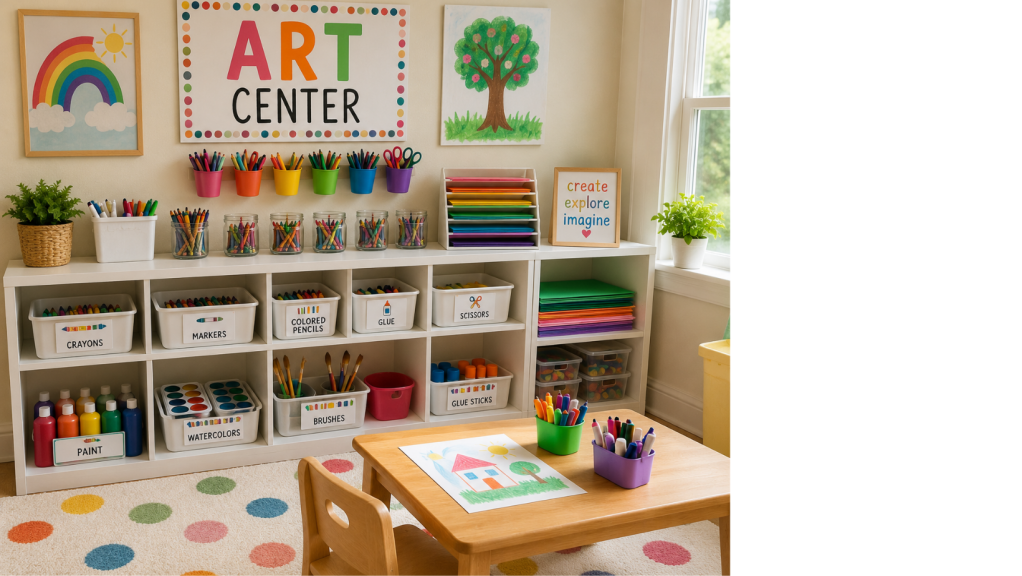
2. Art Center
The art center is one of those spaces that may get a little messy—and that’s okay! Young children need opportunities to create, experiment, and express themselves without worrying about making everything look perfect. In a home daycare, your art center can be as simple as a child-sized table, a few containers of supplies, and a place where children know they are welcome to create.
Art is about much more than making something cute to send home to parents. Every time a child picks up a crayon, squeezes a glue bottle, tears a piece of paper, rolls play dough, or uses scissors, they are developing important skills that will help them later with writing, dressing, using utensils, and other everyday tasks.
Why Art Is Important
Art supports creativity, fine motor development, hand-eye coordination, sensory exploration, decision-making, concentration, and self-expression.
It also gives children something incredibly valuable: the opportunity to make their own choices.
“What color should I use?”
“Where should I put this?”
“What happens if I mix these two colors?”
“How can I make this stick?”
Those little decisions encourage children to think, experiment, and solve problems independently.
What to Put in Your Art Center
You don’t need an enormous collection of craft supplies. Begin with simple, age-appropriate materials and add to your collection over time.
Some of my favorites include:
- Crayons
- Washable markers
- Colored pencils
- Construction paper
- Plain white paper
- Washable paint
- Paintbrushes
- Glue sticks
- Liquid glue
- Child-safe scissors
- Stickers
- Play dough
- Chalk
- Sponges
- Dot markers
- Collage materials
- Craft sticks
- Smocks or old oversized shirts
You can also save inexpensive materials from around your home. Cardboard tubes, small boxes, scraps of wrapping paper, magazines, tissue paper, ribbons, and clean recycled containers can become wonderful art materials.
Just remember to check everything for choking hazards and age appropriateness, especially when caring for children of different ages.
Process Art vs. Crafts
There is absolutely a place for cute crafts in preschool. I love a sweet handprint keepsake just as much as the next mom or teacher! But children also need plenty of opportunities for process art.
Process art focuses more on the experience of creating than on what the finished product looks like.
Instead of saying, “Put the red circle here and the two eyes here,” you might simply provide paint, paper, brushes, and a few interesting materials and allow the child to decide what happens next.
Ten children may participate in the same activity and create ten completely different pieces of art—and that’s wonderful.
Make Art Supplies Accessible—But Be Strategic
For preschool-aged children, I like having basic supplies such as paper and crayons available where children can independently reach them. Other materials, such as paint, glue, or small collage pieces, may need to be stored higher and brought out when an adult can supervise.
You don’t have to put every art supply you own on the shelf at once. Rotate materials. A few thoughtfully chosen options are often more inviting than an overflowing shelf.
And don’t worry about creating a picture-perfect art center. Give children a comfortable place to work, provide interesting materials, and make it clear that their ideas are valued.
Sometimes the masterpiece won’t be what they create on the paper.
Sometimes the masterpiece is everything they learned while creating it.
3. Writing Center
You may be wondering, “Do toddlers and preschoolers really need a writing center if they can’t write yet?” Absolutely! Writing begins long before a child can correctly form letters or write their name. Those first scribbles, lines, circles, drawings, and pretend grocery lists are all part of learning to write.
A writing center gives children a designated place to experiment with print, drawing, letters, and other early literacy skills without turning writing into a formal lesson. Remember, at this age, we aren’t looking for perfect handwriting. We are giving children opportunities to develop the skills they will eventually need to become confident writers.
Why a Writing Center Is Important
Before children can write letters, their little hands have a lot of work to do. Holding crayons, drawing pictures, making marks on paper, using stickers, and experimenting with different writing tools all help strengthen the fine motor skills and hand-eye coordination needed for handwriting.
A writing center can also help children begin to understand that print has meaning.
They see adults making grocery lists, writing notes, signing their names, reading signs, and sending cards. When we give children opportunities to imitate those experiences, writing becomes meaningful instead of something they only do on a worksheet.
What to Put in Your Writing Center
Your writing center doesn’t have to be elaborate. A small table, shelf, or organized container of supplies can work beautifully.
Consider including:
- Crayons
- Washable markers
- Pencils
- Chunky pencils for younger children
- Blank paper
- Lined and unlined paper
- Notepads
- Sticky notes
- Dry-erase boards and markers
- Alphabet cards
- Name cards
- Letter stamps
- Magnetic letters
- Envelopes
- Stickers
- Stencils
- Clipboards
You can change some of the materials throughout the year to keep the center interesting.
Make Writing Part of Their Play
One of the easiest ways to encourage writing is to connect it to the other learning centers.
Put a clipboard and pencil in the dramatic play center so children can take restaurant orders. Add paper near the block center so children can draw plans for their buildings. Let children make grocery lists, birthday cards, signs, menus, labels, or pretend prescriptions for their doctor’s office.
Now writing has a purpose.
Instead of telling a child, “It’s time to practice writing,” you’re creating an environment where the child decides, “I need to write this down!”
That is exactly the kind of early writing experience I want young children to have.
Don’t Correct Every Scribble
When a young child proudly hands you a page filled with scribbles and says, “This says I love Mommy,” resist the urge to tell them that those aren’t real words.
To that child, those marks mean something.
You can respond by saying, “Tell me what you wrote,” or “I love hearing about your story.”
As children develop, their scribbles will begin to look more intentional. Shapes will appear. Then letter-like forms. Eventually, recognizable letters and words will begin showing up.
Celebrate the process.
Create a Print-Rich Environment
Your writing center doesn’t have to do all the work. Look for simple ways to surround children with meaningful print throughout your daycare.
Label shelves and containers with pictures and words. Display children’s names. Add simple signs to learning centers. Keep books throughout the room. Use calendars, menus, charts, and environmental print when appropriate.
When children regularly see print being used in meaningful ways, they begin to understand that reading and writing are part of everyday life.
Your writing center isn’t about pushing preschoolers into academics before they’re ready. It’s about giving little hands plenty of opportunities to draw, scribble, create, experiment with letters, and discover that their marks can have meaning.
4. Math Center
When we think about teaching math to young children, numbers and counting are usually the first things that come to mind. But early math is so much more than learning to count to ten or recognizing a number on a flashcard. Preschoolers are learning math when they sort toys by color, build a repeating pattern, compare which tower is taller, match shapes, fill and empty containers, or figure out how many plates are needed for everyone at the table.
That is why I want my math center to be a place for hands-on exploration, not a place filled with worksheets.
Why a Math Center Is Important
Young children understand mathematical concepts best when they can actually touch and manipulate objects. Before a child truly understands that the numeral 5 represents five objects, they need lots of opportunities to count real things.
A thoughtfully designed math center can introduce children to:
- Counting
- Number recognition
- One-to-one correspondence
- Sorting
- Matching
- Patterns
- Shapes
- Sizes
- Measurement
- Comparing quantities
- Spatial relationships
- Simple problem-solving
These early experiences help build the foundation for the more advanced math children will encounter later in school.
What to Put in Your Math Center
You don’t need expensive math curriculum kits to create a great center. Many simple manipulatives can be used in several different ways.
Consider adding:
- Counting bears or other counters
- Number cards
- Linking cubes
- Pattern blocks
- Shape manipulatives
- Sorting trays
- Pom-poms
- Peg boards
- Puzzles
- Dice
- Dominoes
- Measuring cups
- Measuring spoons
- Rulers
- Number puzzles
- Muffin tins for sorting
- Simple preschool games
Everyday objects can work, too. Bottle caps, large buttons, blocks, toy animals, craft sticks, and other safe household items can become counting and sorting materials. Just be mindful of choking hazards when younger children are in your care.
Start With Sorting
Sorting is one of the easiest early math skills to introduce, and children often do it naturally.
Give children a collection of objects and ask:
“How could we put these into groups?”
You might sort bears by color, buttons by size, animals by type, or blocks by shape. As children become more confident, let them decide how they want to sort the objects.
There isn’t always just one correct answer—and that encourages children to think.
Add Counting Throughout the Day
Math doesn’t need to stay in the math center.
Count children as they line up. Count apple slices at snack. Ask how many cups you need for lunch. Count blocks while building a tower. Look for numbers on signs, calendars, clocks, and food packages.
These everyday experiences help children understand that numbers have meaning in the real world.
Introduce Patterns
Patterns are another wonderful preschool math skill.
Start simply:
Red, blue, red, blue…what comes next?
Children can make patterns using blocks, counting bears, beads, stickers, shapes, or even movements.
Try:
Clap, stomp, clap, stomp.
Now you’re practicing math without even sitting at the math table!
Let Children Solve Problems
Try not to immediately give children the answer when they encounter a challenge.
If a child needs four plates but only brings three to the table, you might ask, “Do we have enough plates for everyone?”
If two towers are different heights, ask, “Which one is taller? How can you tell?”
Questions like these encourage children to observe, compare, count, and think for themselves.
Your math center doesn’t need to feel like a miniature elementary school classroom. Fill it with materials children can count, sort, match, compare, measure, build, and explore.
When math is introduced through play, children begin developing important mathematical thinking long before they ever realize they’re “doing math.”
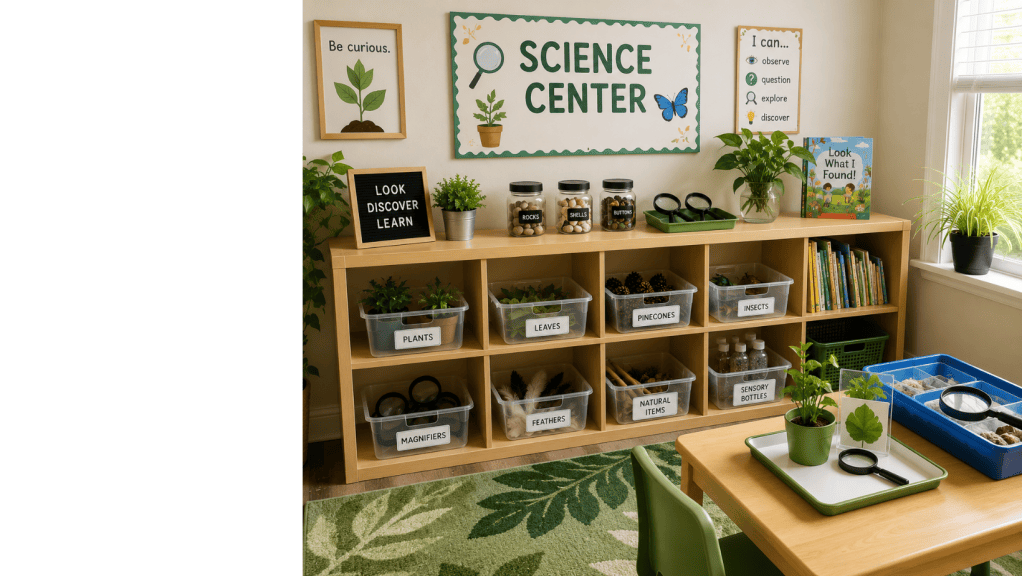
5. Science & Discovery Center
If you’ve ever spent much time with a preschooler, you already know that young children are natural scientists. They want to know why the sky is blue, where bugs live, what happens when you mix things together, why some objects sink, and what is hiding underneath every rock they see.
A science and discovery center gives children a place to slow down, investigate, ask questions, and learn more about the world around them. You don’t need complicated experiments or expensive science equipment. At this age, science can be as simple as giving a child a magnifying glass and something interesting to examine.
Why a Science Center Is Important
Science encourages children to observe, predict, compare, experiment, investigate, and ask questions.
When a child holds a magnet near different objects to see what happens, they are experimenting. When they examine the veins on a leaf with a magnifying glass, they are observing. When they guess whether an object will sink or float, they are making a prediction.
These simple experiences help children develop early scientific thinking while also strengthening vocabulary, problem-solving, attention, and curiosity.
And perhaps most importantly, they learn that it’s okay not to know the answer right away.
Sometimes the best response to a child’s question is:
“I don’t know. How could we find out?”
What to Put in Your Science & Discovery Center
Your science center can be small. A low shelf, table, or collection of rotating baskets can provide plenty of opportunities for exploration.
Consider including:
- Magnifying glasses
- Magnets
- Rocks
- Leaves
- Pinecones
- Seashells
- Feathers
- Safe nature collections
- Mirrors
- Flashlights
- Measuring tools
- Simple balance scales
- Observation containers
- Child-friendly science books
- Pictures of animals and plants
Natural materials are some of my favorite additions because they are inexpensive—or completely free.
Take a walk outside with the children and collect interesting leaves, sticks, rocks, or pinecones. Bring them inside and examine them together.
Suddenly your backyard has become part of your science curriculum.
Rotate Materials With the Seasons
Your science center is a wonderful place to bring the changing seasons indoors.
In the fall, children might investigate leaves, acorns, pumpkins, and pinecones. During spring, you could explore seeds, flowers, insects, and plant growth.
You can also rotate materials according to what the children are interested in. If everyone suddenly becomes fascinated with dinosaurs, bugs, weather, space, or ocean animals, use that curiosity!
Children are much more motivated to learn when we build experiences around questions they are already asking.
Ask Questions Instead of Giving Answers
You don’t need to know everything about science to create meaningful science experiences.
Instead of immediately explaining what will happen, try asking:
“What do you notice?”
“What do you think will happen?”
“Why do you think that happened?”
“How are these two things different?”
“What could we try next?”
These simple questions encourage children to think more deeply and develop their own ideas.
Take Science Outside
Don’t feel like your science center has to stay inside your daycare.
Go outside and look for insects. Watch clouds move across the sky. Listen for birds. Dig in the dirt. Observe what happens after it rains. Plant seeds and watch them grow.
For young children, nature may be the best science center you could ever create.
The goal isn’t to teach preschoolers complicated scientific facts. It’s to protect and encourage something they already have naturally—the desire to wonder, investigate, explore, and discover how their world works.
6. Block Center
The block center may look like a place where children are simply stacking and knocking things down, but there is so much learning happening in those little towers, roads, bridges, and pretend cities. Blocks are one of my favorite open-ended materials because there isn’t one “right” way to play with them. Give several children the same set of blocks, and they may create completely different things.
When children build, they are experimenting with balance, size, shape, space, measurement, and cause and effect. They’re also using creativity, planning, and problem-solving every time they figure out how to make a tower stand or how to build a bridge wide enough for a toy car.
Why Block Play Is Important
A good block center supports development in many areas at the same time.
Children are developing early math skills as they compare sizes, recognize shapes, count blocks, and decide which structures are taller or shorter. They are exploring early engineering concepts when they test which blocks make the strongest base.
Block play also encourages language and social development. When several children build together, they have to share materials, communicate their ideas, negotiate, take turns, and sometimes figure out what to do when someone accidentally knocks down the masterpiece!
These are important skills that children will carry far beyond the block center.
What to Put in Your Block Center
You don’t need every type of building toy available. Start with a good collection of blocks and gradually add accessories that encourage children to expand their play.
Consider including:
- Wooden unit blocks
- Foam blocks
- Cardboard blocks
- Large building blocks
- Magnetic tiles
- Toy cars and trucks
- People figures
- Animal figures
- Road signs
- Trees
- Simple building photographs
- Construction vehicles
You can rotate the accessories depending on children’s interests. Adding dinosaurs one week can completely transform the same blocks children have been playing with for months.
Give Children Enough Room to Build
Placement is especially important for this center.
Children need enough floor space to spread out their creations. If possible, place the block center somewhere that isn’t directly in a major walkway. There is nothing more frustrating to a little builder than spending twenty minutes creating a tower only to have someone knock it over while walking to another center.
A rug can also provide a simple visual boundary and help children understand where block materials should stay.
Add Literacy to Your Block Center
Books and writing aren’t limited to the library and writing centers.
Place pictures of bridges, houses, farms, skyscrapers, or other structures near your blocks. Add a clipboard and paper so children can draw a plan before building. Preschoolers can even create signs for their structures.
“Welcome to our zoo!”
“Stop!”
“Construction Zone!”
Now you’ve combined building with early reading and writing.
Don’t Build It for Them
It can be tempting to step in when a child is struggling to make something work. But sometimes the falling tower is exactly where the learning happens.
Instead of immediately fixing it, try asking:
“What do you think made it fall?”
“What could you put on the bottom to make it stronger?”
“What could you try differently?”
Give children time to experiment.
A tower that falls five times before finally standing may teach far more than a tower an adult built perfectly on the first try.
The block center is a wonderful reminder of what play-based learning really looks like. Children may believe they’re simply building a castle, road, farm, or giant tower, but along the way they’re becoming little mathematicians, engineers, designers, storytellers, and problem-solvers.
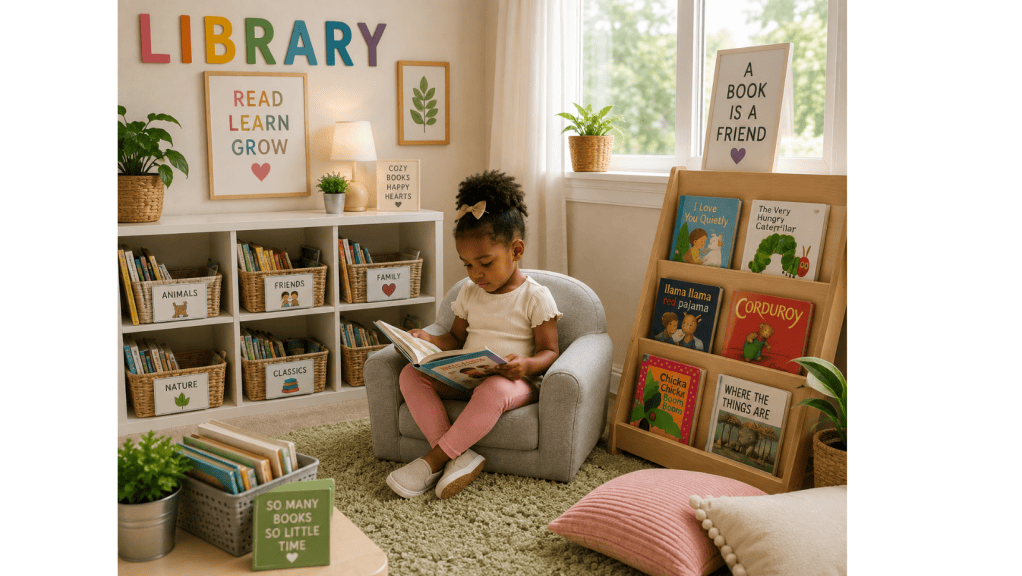
7. Library & Cozy Reading Center
Every home daycare needs a place where little ones can slow down, get comfortable, and enjoy a good book. Your library and reading center doesn’t have to be large or filled with hundreds of books. A quiet corner, a small bookshelf, and a comfortable place to sit can become one of the most valuable spaces in your daycare.
I especially love having a library in a home daycare because reading should feel like a natural part of a child’s day—not something we only do during a scheduled lesson. When books are displayed where children can see and reach them, they can choose to read whenever their curiosity leads them there.
And remember, a child does not have to know how to read words yet to benefit from books. When toddlers and preschoolers turn pages, study pictures, retell familiar stories, or pretend to read to a stuffed animal, they are already developing important early literacy skills.
Why a Library Center Is Important
Books help children develop vocabulary, language, comprehension, listening skills, imagination, print awareness, and a love of reading.
Reading also introduces children to people, places, experiences, and ideas beyond their immediate world. A book can take a child to a farm, under the ocean, into space, or inside the life cycle of a butterfly—all without leaving your daycare.
Books can also help children understand their own experiences. Stories about starting preschool, welcoming a new baby, making friends, experiencing big emotions, or learning to use the potty can give children a safe way to talk about things happening in their lives.
What to Put in Your Library Center
Choose a variety of developmentally appropriate books, including:
- Board books
- Picture books
- Alphabet books
- Counting books
- Nursery rhymes
- Rhyming books
- Simple nonfiction books
- Books about animals and nature
- Books about feelings
- Books showing different families and communities
- Seasonal books
- Familiar favorite stories
For younger children, sturdy board books are especially helpful because they can withstand lots of little hands.
Make Books Easy to See
Whenever possible, display at least some books with the covers facing forward.
Young children often choose books based on the pictures on the cover rather than the title on the spine. Front-facing shelves, small book displays, or baskets can make books much more inviting.
You don’t have to put every book you own out at once, either.
Keep some favorites available all the time and rotate others according to the season, your current theme, or children’s interests. Rotating books can make an old collection feel brand new.
Make It Cozy
Your library should feel a little different from the busier areas of the daycare.
Depending on your space, you might add:
- A small rug
- Floor cushions
- Child-sized chairs
- A soft mat
- Stuffed reading buddies
- A small couch or comfortable seating
Keep the area simple and uncluttered. You want children to associate this space with feeling comfortable, calm, and welcome.
Read Aloud Every Day
Having a beautiful library doesn’t replace one of the most important things we can do for young children: read to them.
Read stories during group time. Read one-on-one. Read the same favorite book for the tenth time when they ask for it again. Talk about the pictures. Ask what they think will happen next. Laugh at the silly parts and let them help tell familiar stories.
You don’t have to turn every book into a lesson.
Sometimes, simply sitting together and enjoying a story is enough.
Let Children “Read” Too
If a preschooler picks up a familiar book and begins telling the story from memory, let them.
If a toddler flips through the pages and talks about the pictures, listen.
If a child lines up stuffed animals and announces that it’s story time, encourage it.
These moments may look like pretend play, but children are beginning to understand how books work and seeing themselves as readers.
The goal of your library isn’t to see how quickly you can teach a preschooler to read independently. It’s to create a place where children learn that books are interesting, stories are exciting, and reading is something worth loving.
8. Sensory Center
If you’ve ever watched a young child happily scoop and pour water from one container to another over and over again, you already understand the appeal of a sensory center. Children naturally want to touch, squeeze, pour, scoop, dig, mix, and explore. Sensory play gives them a safe and intentional place to do just that.
And while it may look like children are simply playing in a bin of water or sand, there is actually a lot of learning taking place.
Why Sensory Play Is Important
Sensory experiences allow children to explore the world using their senses. As they scoop, pour, squeeze, transfer, and manipulate materials, they can develop fine motor skills, hand-eye coordination, concentration, problem-solving, language, and early math and science concepts.
Think about a child pouring water between two containers. They are beginning to explore concepts such as full, empty, more, less, heavy, light, volume, and cause and effect.
Add another child to the table, and now there are opportunities for sharing, taking turns, communicating, and cooperative play.
What to Put in Your Sensory Center
Your sensory center can change throughout the year. Depending on the children’s ages and the level of supervision available, you might explore materials such as:
- Water
- Sand
- Kinetic sand
- Play dough
- Large pom-poms
- Age-appropriate dry materials
- Scoops
- Cups
- Funnels
- Bowls
- Measuring cups
- Spoons
- Tongs
- Small containers
- Sponges
You don’t need a large commercial sensory table, either. A sturdy plastic bin or shallow container can work perfectly well for many activities.
Sensory Play Doesn’t Have to Be Complicated
Some of the best sensory activities are incredibly simple.
Put water in a bin and add cups.
Give children play dough with a rolling pin and cookie cutters.
Add sponges to a small amount of water and let children squeeze and transfer it between containers.
You don’t have to create an elaborate themed sensory bin every week. The purpose is to give children interesting materials they can explore and manipulate, not to create something that looks perfect in a photograph.
Add Vocabulary While Children Play
Sensory play creates wonderful opportunities for conversation.
You might introduce words such as:
Wet. Dry. Rough. Smooth. Soft. Hard. Heavy. Light. Full. Empty. Sticky. Cold. Warm.
Instead of quizzing children, simply use these words naturally while you play alongside them.
“That sponge is soaking wet!”
“Your cup is almost full.”
“This one feels rough. How does yours feel?”
These little conversations help children connect new vocabulary with something they can actually experience.
Safety Comes First
Sensory play is one area where you really need to consider the ages of the children in your care.
Materials such as dry rice, beans, small pasta, beads, or other small sensory fillers may present choking or other safety hazards for babies and young toddlers. Just because an activity is labeled “preschool sensory play” online doesn’t mean it is appropriate for every child in your daycare.
Choose materials based on the youngest children who can access the area, supervise sensory activities carefully, and store materials that aren’t appropriate for younger children out of reach.
Also remember that water requires close, active supervision, even when you’re only using a small amount.
Take Sensory Play Beyond the Sensory Bin
A sensory center doesn’t always have to mean filling a container with something.
Children experience sensory learning when they:
- Dig in the garden
- Splash in water
- Paint with their fingers
- Knead dough
- Play with bubbles
- Walk barefoot on grass
- Explore mud
- Smell flowers
- Listen to nature sounds
- Handle leaves, sticks, and other natural materials
Sensory exploration is happening all around us.
Your job isn’t to create an elaborate sensory experience every day. It’s simply to provide safe opportunities for children to touch, explore, experiment, and discover.
And yes—sometimes that means there will be a little mess.
In early childhood, some of the best learning usually is.
You Don’t Need Eight Huge Areas
After reading about eight different learning centers, you may be looking around your home thinking, “Where in the world am I supposed to put all of this?”
The good news is—you don’t need eight separate rooms, eight large corners, or even eight pieces of furniture.
Remember, we’re creating a home daycare, not trying to squeeze an entire preschool building into our living room.
A learning center is really just an intentionally designed space where children know what they can do and what materials are available. Depending on the size of your home, a center might be an entire corner of a room, but it could just as easily be one shelf, a basket, a small table, a rolling cart, or a section of a larger space.
Let Centers Share Space
Some learning centers naturally work well together.
Your writing and art centers might share the same table. Keep crayons, pencils, paper, and basic writing materials accessible while storing paints and messier art supplies until you’re ready to use them.
Your math and science centers could share a shelving unit, with math manipulatives stored on one side and discovery materials on the other.
Even your daycare tables can serve multiple purposes throughout the day. The same table might be used for writing in the morning, an art activity before lunch, and then cleaned and prepared for mealtime.
In a home daycare, multipurpose is a wonderful thing.
Use Baskets and Portable Centers
Not every center needs to stay out all day.
Create baskets or bins that can easily be brought out when children want to use them. A math basket might contain counting bears, number cards, and sorting cups. A science basket could hold magnifying glasses, magnets, and interesting natural materials.
When you’re finished, put the basket away.
This is especially helpful if your daycare shares space with your family’s living areas.
Rotate Instead of Adding More
You also don’t need every toy and learning material you own available at the same time.
In fact, fewer carefully selected materials can make a center feel more inviting and less overwhelming.
Keep some materials available and store the rest. Every few weeks—or whenever children’s interest begins to fade—switch a few things.
Suddenly those toys that have been sitting in a closet for a month feel exciting again.
Rotating materials also helps keep your daycare from becoming cluttered and makes cleanup much easier.
Use Your Walls and Vertical Space
When floor space is limited, look up!
Wall space can be used for alphabet displays, children’s artwork, visual schedules, learning posters, family photographs, or other materials that support your program.
Just be intentional. You don’t need to cover every inch of your walls.
I prefer a space that feels warm and inviting rather than visually overwhelming. Children’s work and meaningful materials should be the stars of the room.
Your Home Doesn’t Have to Look Like a School
This may be one of the most important things to remember when designing a home daycare.
Your home is part of what makes your program special.
You can have organized shelves, labeled centers, educational materials, and thoughtfully planned activities while still allowing your space to feel comfortable, cozy, and home-like.
You don’t need rows of desks.
You don’t need a giant classroom.
And you certainly don’t need to buy everything before you begin.
Start with the space you have. Create the centers that are most important to you. Watch how the children use them, and make changes as you go.
A small, thoughtfully designed learning space can offer children just as many wonderful opportunities to play, explore, create, and learn as a much larger classroom.
Separate Quiet and Active Learning Centers
Once you’ve decided where your learning centers will go, think about how the different areas work together. One of the easiest ways to make a home daycare feel calmer and more organized is to separate your quiet learning centers from your louder, more active ones.
Imagine trying to curl up with a good book while two preschoolers are building a giant block tower beside you and another child is pretending to run a busy restaurant. There’s nothing wrong with any of that play—but those activities don’t necessarily belong right next to one another!
Which Centers Are Active?
Your more active centers will usually include:
- Dramatic play
- Blocks
- Sensory
- Some art activities
These areas tend to involve more movement, conversation, materials spread across the floor, and children working together.
Whenever possible, I like to place dramatic play and blocks near each other. Both encourage imaginative and cooperative play, and children often naturally carry ideas from one center into the other.
For example, children may build a house with blocks and then bring dolls over to live in it. They might build a road leading to their pretend grocery store or construct a barn for the animals from dramatic play.
That’s learning centers working together!
Which Centers Are Quieter?
Your quieter areas might include:
- Library
- Writing
- Math
- Science and discovery
These centers often require a little more concentration and usually work best away from the busiest areas of the room.
Your library, in particular, should be placed somewhere children can settle down without constantly having other children walking through their space.
Think About Traffic Flow
As you arrange your centers, get down on the children’s level and look around the room.
Ask yourself:
Can children move easily from one center to another?
Are there areas where children will constantly bump into each other?
Will children have to walk through the block center to reach the bathroom?
Can I see every center from where I will normally be supervising?
Sometimes moving one shelf or turning a table in a different direction can completely change how well a room functions.
Use Furniture to Create Boundaries
You don’t necessarily need walls or dividers between centers.
Low shelving units, rugs, tables, and other furniture can create simple visual boundaries that tell children, “This is where this activity belongs.”
A rug might define your block center. A small bookshelf and cozy chair can establish your library. A table beside an art shelf can clearly identify your creative area.
These boundaries can also make cleanup easier because children begin to understand where materials belong.
But Don’t Completely Separate Everything
Although we call them individual “centers,” learning doesn’t happen in little boxes.
It’s perfectly okay for children to take their ideas from one area into another.
A child might find a book about construction in the library and decide to build the same building with blocks. Another child might make a menu in the writing center and carry it into dramatic play. Someone exploring leaves in the science center may decide to use those observations as inspiration for an art project.
Those connections are exactly what we want.
The goal of arranging learning centers isn’t to control every part of children’s play. It’s to create an environment that feels organized enough to function well but flexible enough for children’s ideas to grow.
When your room has a good balance between busy spaces and peaceful spaces, you’ll often find that children are able to stay engaged longer—and your home daycare feels calmer, too.
Keep Materials at Child Level
One of the simplest ways to encourage independence in your home daycare is to put appropriate materials where children can actually reach them. When children can see their choices, select what they want to use, and return materials when they’re finished, the environment begins doing some of the teaching for you.
Low, open shelving works especially well in learning centers. Instead of digging through a large toy box, children can clearly see the blocks, puzzles, books, art materials, or manipulatives that are available to them.
Give Everything a Home
Young children are much more capable of helping with cleanup when they know exactly where things belong.
Try organizing materials in:
- Baskets
- Small bins
- Clear containers
- Trays
- Low shelving
- Book displays
You can also add picture-and-word labels to shelves and containers. For example, a block basket might have a photograph or simple picture of blocks along with the word Blocks.
The picture helps younger children identify where the materials belong, while the printed word adds another opportunity to see meaningful print in their environment.
Independence Is Part of the Learning
It may seem easier to keep everything stored away and hand children materials whenever they need them, but allowing children to make appropriate choices teaches important life skills.
Children begin learning:
“I can choose what I want to work with.”
“I know where to find it.”
“I can use it appropriately.”
“I can put it back when I’m finished.”
Those are early lessons in responsibility, organization, decision-making, and independence.
Not Everything Should Be Within Reach
Child-accessible doesn’t mean everything needs to be available all day.
Some materials should remain stored away and only be brought out with adult supervision. Depending on the ages in your daycare, this might include paint, glue, scissors, small manipulatives, certain sensory materials, or anything that could present a choking or safety hazard.
This is especially important in a mixed-age home daycare. A math manipulative that is perfectly appropriate for a four-year-old may be unsafe for a one-year-old who shares the same room.
I like to think of materials in two groups: “You may choose this independently” and “We use this with a grown-up.”
Don’t Put Too Much on the Shelves
Child-level shelves don’t need to be packed from one end to the other.
A few carefully selected choices are often better than dozens of toys competing for children’s attention. Leave a little breathing room between baskets and materials so children can easily see what’s available.
If you have more toys than you have shelf space, that’s actually a good thing—you can rotate them.
Keeping your learning centers simple, organized, and accessible can make the entire daycare run more smoothly. When children know where materials are and where they belong, they’re not only becoming more independent—they’re learning that this space was thoughtfully created for them.
Don’t Overfill Your Learning Centers
When you’re excited about creating a home daycare, it is very easy to fall into the trap of thinking you need more. More toys, more manipulatives, more books, more decorations, more bins, and more activities.
But when it comes to learning centers, more isn’t always better.
Too many choices can make a space feel cluttered and overwhelming. Children may move quickly from one toy to another instead of settling into meaningful play. And from a practical standpoint, an overcrowded room usually means more things scattered across the floor and a much bigger cleanup at the end of the day.
Choose Materials With a Purpose
Before adding something to a learning center, ask yourself:
What can children do with this?
What skills might they practice?
Does it encourage creativity or exploration?
Do I already have something that serves the same purpose?
Not every toy has to be “educational” in the traditional sense. A baby doll, wooden block, toy truck, or basket of pretend food can lead to incredible learning.
The goal is to choose materials that invite children to play, think, create, communicate, and explore.
Start With Less
When you’re first setting up your centers, resist the urge to put everything out.
Your block center doesn’t need five different types of blocks. Your dramatic play kitchen doesn’t need every piece of pretend food you own. Your library doesn’t need 100 books available at once.
Start with a manageable selection and observe what happens.
Which materials do children choose?
Which ones hold their attention?
Which ones are ignored?
Which areas become messy without producing much meaningful play?
Those observations can tell you far more about what your daycare needs than a shopping list ever could.
Rotate Your Toys and Materials
Instead of continually buying more, create a simple toy rotation system.
Keep some materials available and store others out of sight. Every few weeks, switch a few things based on the children’s interests, developmental needs, seasons, or themes.
You might replace farm animals with dinosaurs in the block center, add new puzzles to the math area, change the books in your library, or introduce different tools at the sensory table.
When familiar materials disappear for a while and return later, children often approach them with renewed interest.
It’s almost like getting new toys—without spending any money.
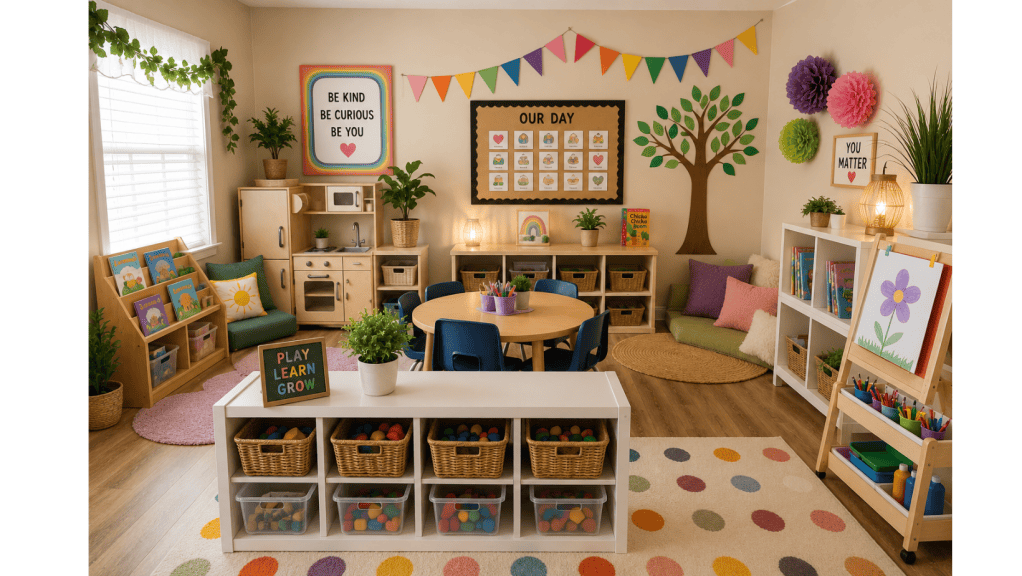
Leave Room for Children to Create
Not every shelf needs to be full.
Not every wall needs a poster.
Not every table needs an activity waiting on it.
Children need physical and visual space to think, move, build, and create.
I want my home daycare to feel inviting and interesting without feeling overwhelming. I would rather have a smaller collection of materials children truly engage with than a room packed with toys they barely notice.
Your learning centers don’t have to impress another adult walking into the room.
They need to work for the children who play there every day.
So give yourself permission to keep things simple. Start with what you have, watch your children, rotate materials when needed, and add things intentionally.
A thoughtfully prepared space will almost always offer more meaningful learning than a room that simply has more stuff.
Final Thoughts
Creating learning centers in your home daycare doesn’t mean you have to turn your home into a traditional classroom. In fact, I think one of the most beautiful things about a home daycare is that children can receive intentional, high-quality learning experiences while still enjoying the comfort and warmth of a home environment.
Whether you have an entire room dedicated to your daycare or you’re working with a corner of your living room, you can create meaningful spaces for children to learn. A basket of books can become a library. A rug and a set of blocks can become a construction zone. Paper and crayons at the kitchen table can become a writing or art center. You don’t need a huge space—you need to be intentional with the space you have.
As I design my own home daycare, I’m reminding myself that I don’t have to get everything perfect from the beginning. My dramatic play, art, writing, math, science, blocks, library, and sensory centers can change as I learn what works best for the children in my care. I can move furniture, rotate toys, add new materials, and take things away. A good early childhood environment should grow right along with the children who use it.
Most importantly, remember why we’re creating these spaces in the first place. It isn’t to have the prettiest daycare on Pinterest or shelves filled with the latest educational toys. It’s to give children opportunities to pretend, build, investigate, create, read, talk, solve problems, make choices, and discover what they’re capable of doing.
And for my homeschooling parents, these same ideas can work beautifully in your home, too. You don’t need a separate homeschool classroom to create meaningful learning centers for your little one. Start with one or two areas, use what you already have, and build from there.
At the end of the day, children don’t need perfection. They need safe spaces to explore, caring adults who encourage their curiosity, and plenty of time to play.
So start with the space you have. Keep it simple. Make it inviting. Follow your children’s interests.
And then let them play—because in early childhood, play is where some of the very best learning begins.


Leave a Reply