
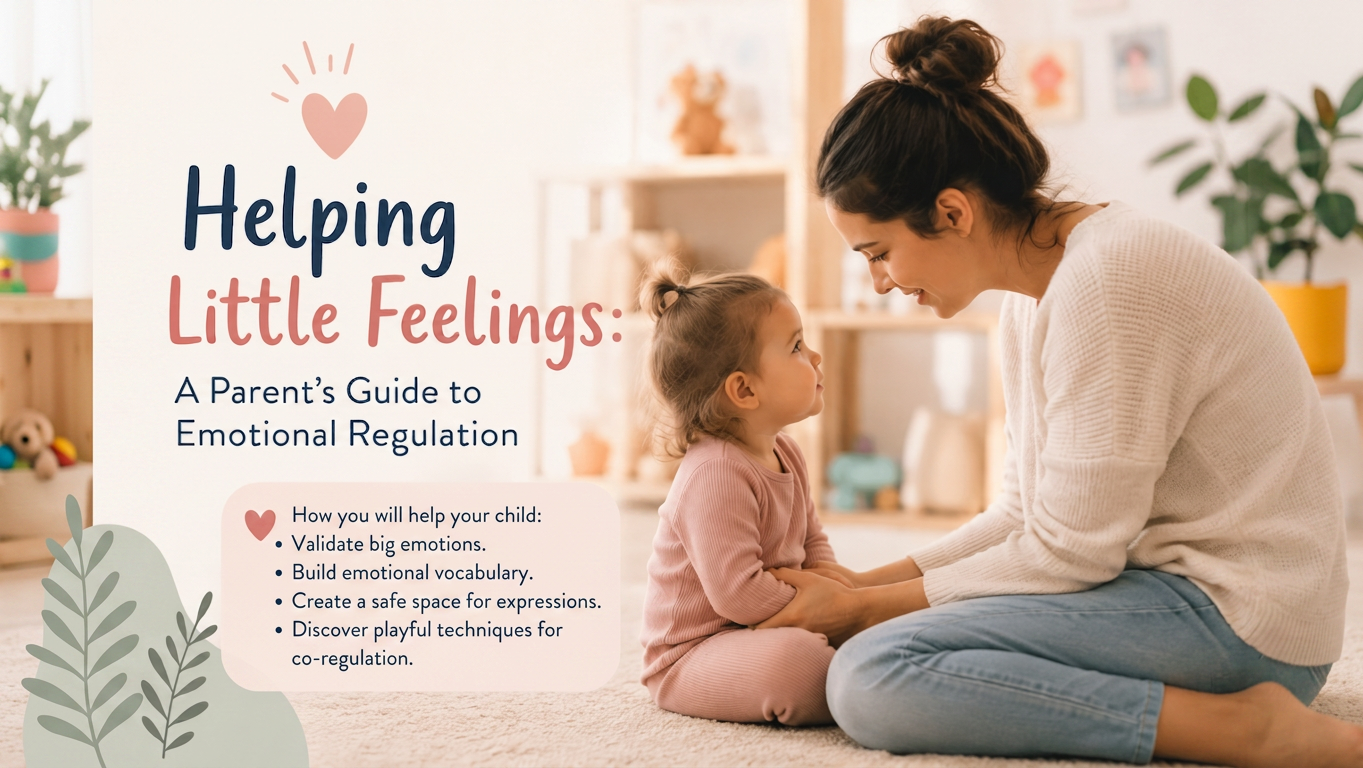
Every child experiences big emotions. Whether it’s a toddler melting down because their banana broke in half or a preschooler crying over a lost toy, these moments are a normal part of growing up. As parents, it can be difficult to know exactly what to say or do when emotions run high. The good news is that emotional regulation is a skill—and like any skill, it can be learned with patience, practice, and loving support
How This Guide Will Help You and Your Child
In this guide, you’ll discover simple, play-based strategies that help your child understand and manage their feelings while strengthening the connection you share. Instead of focusing only on stopping tantrums, we’ll look at what your child is trying to communicate and how you can respond in ways that build trust, confidence, and emotional resilience.
Together We’ll Learn How To:
❤️ Validate Big Emotions
Children need to know that all feelings are welcome—even the uncomfortable ones. Anger, frustration, sadness, disappointment, and fear are not “bad” emotions. When we acknowledge our child’s feelings without judgment, we teach them that emotions are safe to experience and express. Validation doesn’t mean agreeing with every behavior; it means helping children feel seen, heard, and understood.
💬 Build Emotional Vocabulary
Young children often act out because they don’t yet have the words to explain what they’re feeling. We’ll explore fun and engaging ways to teach emotion words through everyday conversations, books, games, and play. As your child’s emotional vocabulary grows, so does their ability to communicate instead of becoming overwhelmed.
🏡 Create a Safe Space for Expression
Children thrive when they know they can come to a trusted adult without fear of shame or punishment. You’ll learn how to create a calm, supportive environment where your child feels safe talking about feelings, asking questions, making mistakes, and working through difficult emotions together.
🎲 Discover Playful Techniques for Co-Regulation
Before children can regulate themselves, they first learn to regulate with a caring adult. This is called co-regulation, and it’s one of the most powerful gifts we can offer our children. Throughout this guide, you’ll discover simple games, movement activities, breathing exercises, sensory play, pretend play, and connection-based strategies that help calm big emotions while making learning fun.
By the end of this guide, you’ll have practical tools you can use during everyday moments—from minor frustrations to full-blown tantrums. Most importantly, you’ll learn how these challenging moments can become opportunities to strengthen your relationship and help your child develop emotional skills that will benefit them for a lifetime
Hi! Im Velvet Mumma
Mom. Early Childhood Professional. Blogger

As an amazon affiliate, I do earn commition on products I suggest.
What Is Emotional Regulation?
Before we talk about tantrums, meltdowns, and big feelings, let’s first understand what emotional regulation really means.
Emotional regulation is the ability to recognize, understand, and manage our emotions in healthy ways. It doesn’t mean children never cry, get angry, or become frustrated. Instead, it means they gradually learn how to express those feelings safely, recover from difficult moments, and return to a calm state.
The important thing to remember is this:
Children are not born knowing how to regulate their emotions.
Just as babies aren’t born knowing how to crawl, walk, or talk, they also aren’t born knowing how to calm themselves when they’re overwhelmed. Emotional regulation is a skill that develops over many years with the help of caring adults.
Think of yourself as your child’s emotional coach.
Every time you comfort your child, help them name their feelings, or remain calm during a difficult moment, you’re teaching their brain how to respond to emotions. These everyday moments are shaping the foundation for emotional health that will benefit them throughout childhood and beyond.
The early years—from birth through age five—are especially important because a child’s brain is developing rapidly. During this time, loving relationships, playful interactions, and consistent responses help children build the skills they’ll need to regulate their emotions independently one day
Why Young Children Have Tantrums
- Tantrums are one of the most challenging parts of parenting—but they’re also one of the most misunderstood.Many people assume tantrums are simply bad behavior or a child trying to “get their way.” While children certainly test limits at times, most tantrums happen because a child is overwhelmed by emotions they don’t yet know how to manage.Imagine having the biggest feelings you’ve ever experienced but not having the words to explain them or the ability to calm yourself down.That’s what life is like for many toddlers and preschoolers.A tantrum can happen because your child is:
- Hungry or tired
- Overstimulated by noise, lights, or busy environments
- Frustrated because something is difficult
- Disappointed when they hear “no”
- Struggling with a transition
- Feeling scared or uncertain
- Unable to communicate what they need
When children become emotionally overwhelmed, their behavior is often a signal that they need support—not shame
This doesn’t mean every behavior should be accepted. Children still need boundaries. However, understanding the reason behind the behavior allows us to respond with both compassion and consistency.
Remember:
All behavior is communication.
When we learn to ask, “What is my child trying to tell me?” instead of “How do I stop this behavior?” we begin responding in ways that truly help our children grow
How Parents Can Respond Calmly
Your calm is one of the most powerful tools you have.
Children borrow our nervous system before they learn to regulate their own. When we stay calm—even when our child is not—we communicate safety, security, and love.
That doesn’t mean parenting is easy.
You’ll have moments when you’re frustrated, exhausted, or unsure what to do. That’s normal. Emotional regulation is something parents continue learning too.
Here are a few simple ways to respond during a tantrum:
1. Pause Before Reacting
Take one slow breath before speaking. Your calm response helps prevent the situation from escalating.
2. Get Down on Their Level
Kneel so you’re at eye level. A gentle presence often feels less threatening than standing over a child.
3. Validate the Feeling
Try saying:
- “You’re really disappointed.”
- “That made you feel angry.”
- “I know this is hard.”
- “I’m here with you.”
Validation tells children their feelings matter while still allowing you to maintain healthy limits.
4. Keep Boundaries Calm and Consistent
Feelings are always welcome.
Unsafe behaviors are not.
You can calmly say:
“I won’t let you hit.”
“It’s okay to be angry. It’s not okay to hurt people.”
Children need both empathy and clear expectations.
5. Offer Comfort Without Forcing It
Some children want a hug.
Others need a little space while knowing you’re nearby.
Follow your child’s cues while remaining emotionally available.
6. Teach Later—Not During the Tantrum
Once everyone is calm, talk about what happened.
Ask questions like:
- “What were you feeling?”
- “What could we try next time?”
- “How can I help you when you feel that way again?”
These conversations build emotional awareness far more effectively than correcting in the middle of a meltdown.
10 Play-Based Emotional Regulation Activities That Really Work
One of the best ways to teach emotional regulation isn’t during a tantrum—it’s through everyday play.When children are relaxed and having fun, their brains are more open to learning new skills. By practicing calming techniques during happy moments, children are much more likely to remember them when big emotions arise.Here are ten simple activities you can begin using today.
1. Make Funny Faces in the Mirror
What You’ll Need: A mirror
Stand in front of a mirror with your child and take turns making different facial expressions.
Try:
- Happy
- Sad
- Angry
- Surprised
- Silly
- Scared
- Excited
- Worried
2. Create a Feelings Check-In Routine
Choose a regular time every day—perhaps breakfast, after school, or bedtime.
Ask:
- “How are you feeling today?”
- “What made you smile?”
- “Was anything hard today?”
Young children may enjoy pointing to feeling faces or choosing an emotion card.
Remember that there are no wrong answers.
The goal isn’t to fix feelings—it’s to make talking about emotions a normal part of family life.
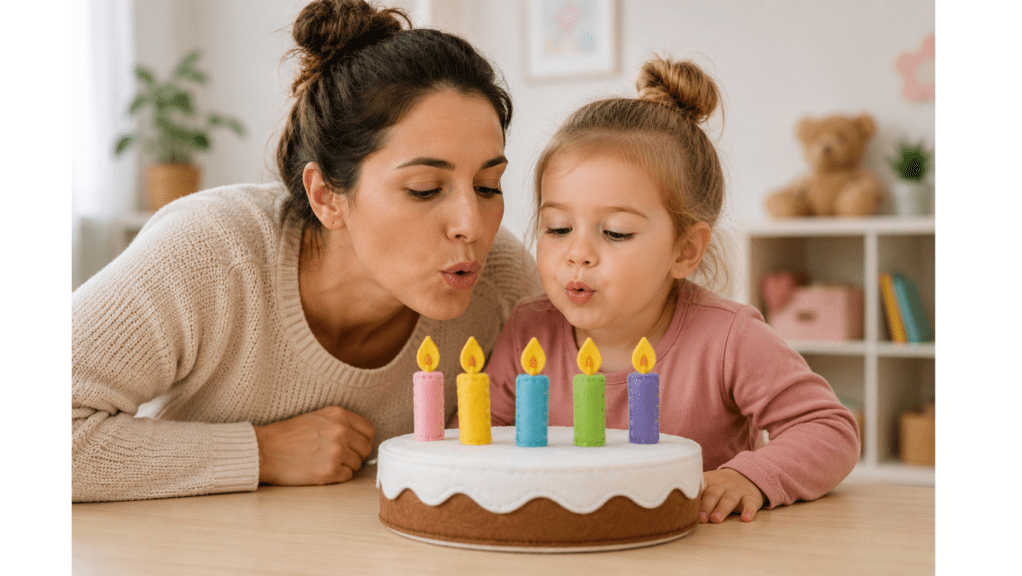
3. Blow the Birthday Candles
Pretend you’re holding a birthday cake with lots of candles.
Take a deep breath through your nose.
Slowly blow out one candle at a time.
Count together:
“One…”
“Two…”
“Three…”
Repeat several times while making it playful.
You can even hold up fingers as pretend candles.
4. The Feelings Color Hunt
Choose one feeling.
For example:
“Today we’re looking for things that make us feel happy.”
Walk around your house or outside together.
Each time your child finds something that matches that feeling, talk about why.
Example:
“My blanket makes me feel safe.”
“The flowers make me feel peaceful.”
“My teddy bear helps me feel calm.”

5. Calm Like an Animal
Invite your child to pretend to be different animals while practicing calming movements.
Try:
🐢 Turtle — Pull into your shell and take slow breaths.
🦁 Lion — Take one deep breath and let out a giant roar.
🐘 Elephant — Swing your trunk while taking slow breaths.
🐱 Sleeping Cat — Curl up quietly for one minute.
🦋 Butterfly — Slowly flap your wings while breathing in and out.
6. Create a Calm-Down Jar
What You’ll Need:
- A clear plastic bottle or jar
- Warm water
- Clear glue or glitter glue
- Fine glitter
- Food coloring (optional)
Fill the bottle with water, glue, and glitter. Shake it up together and watch the glitter slowly settle.
Encourage your child to take slow breaths while watching the glitter fall.
You might say:
“Let’s watch the glitter settle while our bodies settle too.”
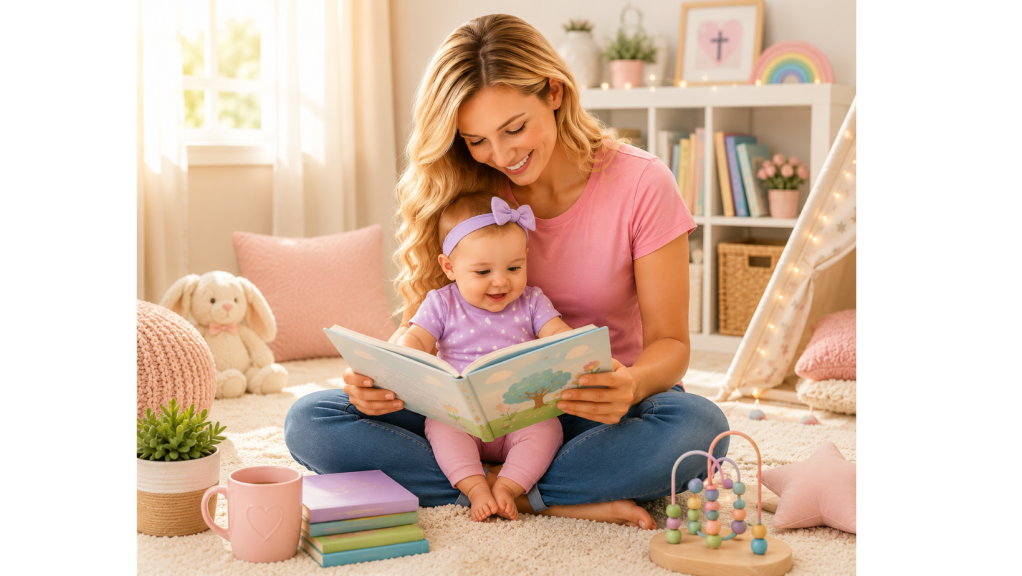
7. Read Books About Feelings
Books are wonderful conversation starters.
Choose stories where characters experience different emotions and pause occasionally to ask questions like:
- “How do you think the character feels?”
- “What happened to make them feel that way?”
- “What would you do?”
- “Have you ever felt like that?”
Reading together helps children understand that everyone experiences a wide range of emotions.
8. Build a Cozy Calm Corner
Designate a small area in your home where your child can go when they need to calm their body.
Include comforting items such as:
- Soft pillows
- Favorite stuffed animals
- Books
- A cozy blanket
- Fidget toys
- Sensory bottles
- Feelings cards
Remember, this is not a time-out space or a punishment area.
Instead, it’s a place where children learn healthy ways to calm themselves with your support.
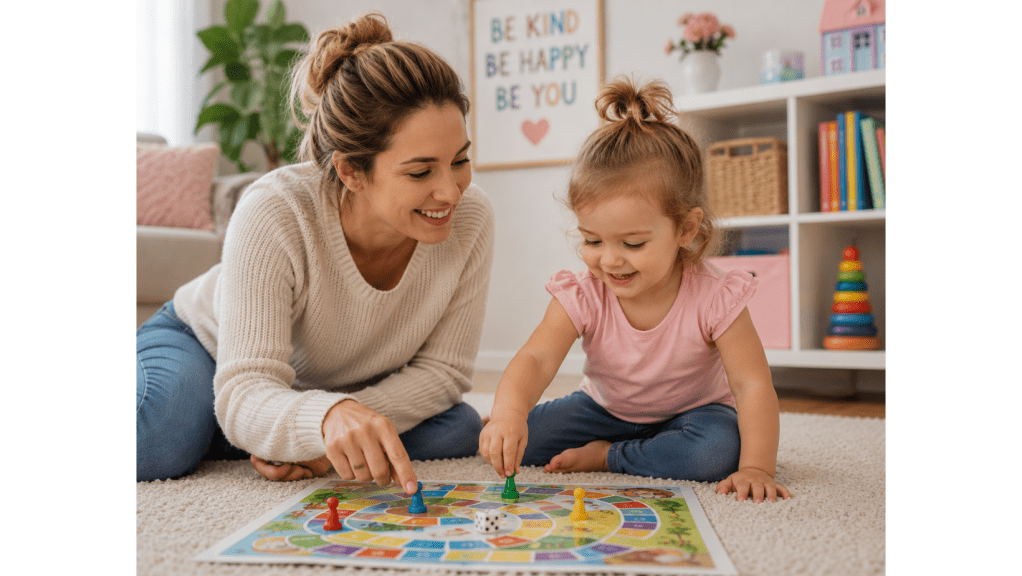
9. Practice Taking Turns Through Games
Simple games teach patience, flexibility, and self-control.
Try activities like:
- Rolling a ball back and forth
- Matching games
- Candy Land
- Memory games
- Building towers together
- Simon Says
playing, model phrases like:
“It’s your turn now.”
“Waiting can be hard, but you’re doing a great job.”
“Let’s cheer each other on!”
10. Role-Play Everyday Challenges
Children often learn best through pretend play.
Use dolls, stuffed animals, or action figures to act out common situations such as:
- Sharing toys
- Leaving the playground
- Going to bed
- Visiting the doctor
- Losing a game
- Feeling frustrated
Ask your child:
- “How is Teddy feeling?”
- “What could Bunny do to calm down?”
- “Can we help Bear solve the problem?”
Then practice taking deep breaths, asking for help, or using kind words.
Final Thoughts
Parenting through big emotions isn’t always easy. There will be days when you feel patient and confident, and there will be days when you’re simply trying your best. Remember, emotional regulation is a journey—for your child and for you.
Every time you pause before reacting, validate your child’s feelings, read a book together, blow out pretend birthday candles, or laugh through a game of pretend play, you’re doing something incredibly important. You’re helping your child build lifelong skills that will allow them to communicate, solve problems, develop healthy relationships, and face challenges with confidence.
Progress doesn’t happen overnight. Emotional regulation develops one loving interaction at a time. Celebrate the small victories, extend yourself grace when things don’t go as planned, and remember that your calm presence is one of the greatest gifts you can give your child.
 mumma's Babies
Leave a comment